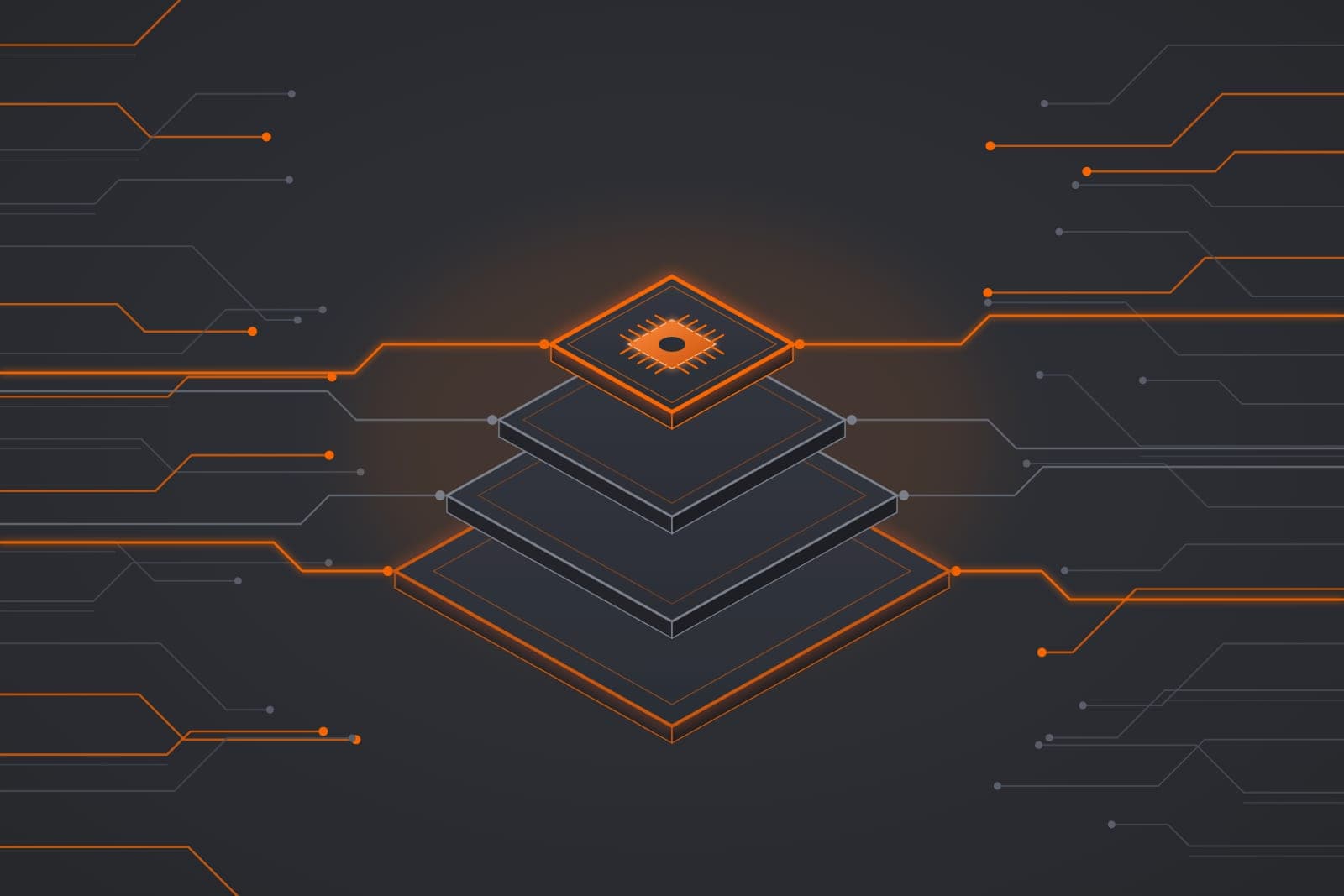
Our AI engine works by stacking four layers of AI engineering to build software: the prompt, the context, the harness and the loop. A model writes the code, but separate agents check it, machines decide whether it passes, and the engine is built to record every step. It is designed so that no AI grades its own work.
This is the technical version of our plain-English tour, how we build software with AI. It is written for owners who want to know what is under the hood, and for developers who want to know whether it holds up. If you want the step-by-step tour first, start there.
The problem: one AI, grading its own homework
Anyone can ask an AI chat tool to write code now. Generating code is no longer the hard part. Shipping software that still works when real customers touch it is. The usual setup lets one model write, review and declare its own work done, a single point of failure with a conflict of interest built in.
The usual setup is one model in one chat window. It writes the work, reviews the work, and declares the work done. It is a single point of failure with a conflict of interest built in. The same model that made a wrong assumption is the one asked to spot it, and it tends to agree with itself.
The results are familiar:
- Software that looks finished in a demo and breaks on the first odd input.
- Parts of the request that quietly go missing, because nothing tracked them.
- No memory. Tomorrow's session starts from zero and repeats yesterday's mistakes.
A smarter model makes better drafts. It does not fix the structure. Checks and balances do, and they take engineering on four layers.
The four layers of AI engineering
Each layer wraps the one before it. A great prompt without context still guesses. Context without a harness still drifts. A harness without a loop still waits on a person to push it along. From the inside out, the four layers are the prompt, the context, the harness and the loop.
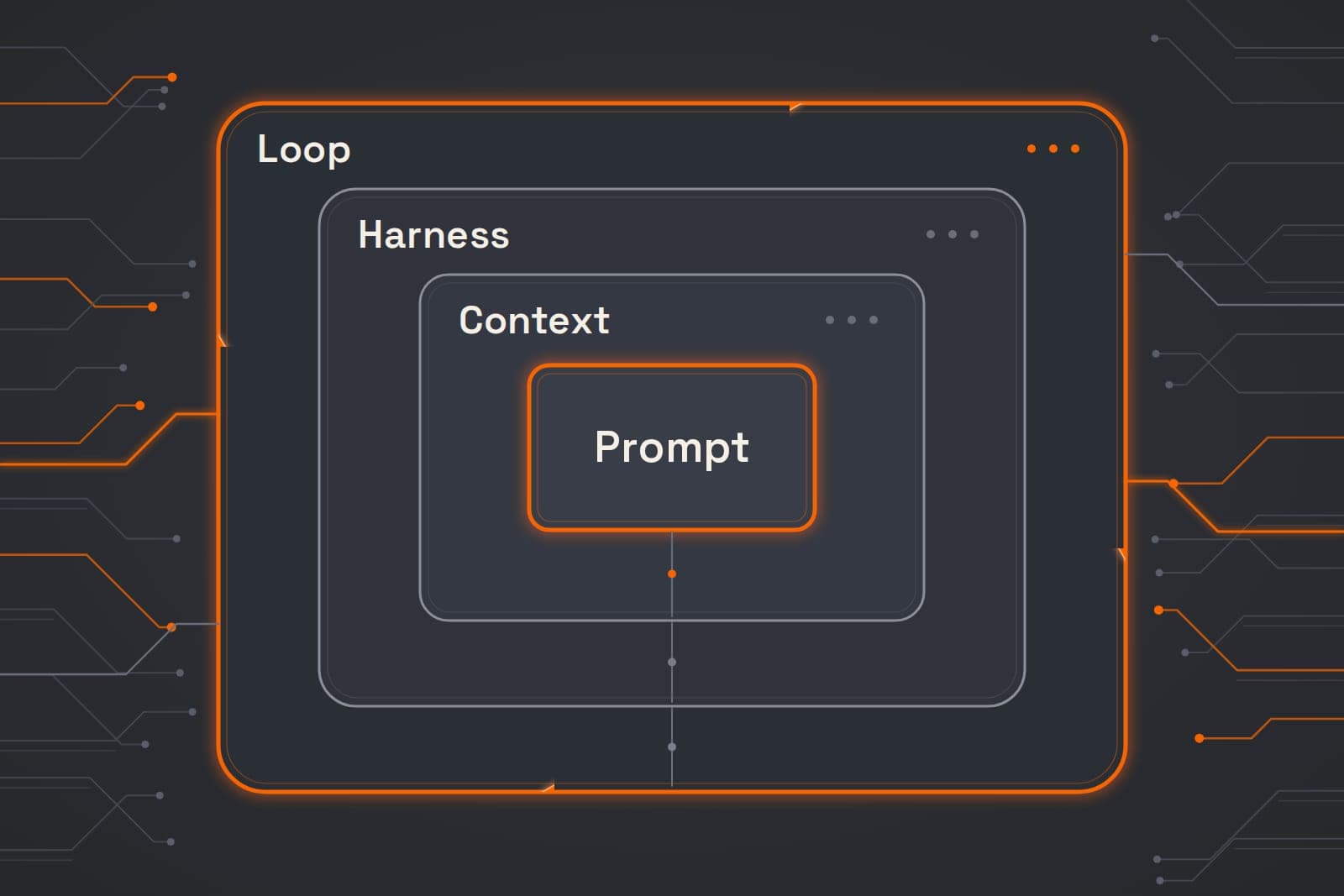
Layer 1: Prompt engineering
The prompt is the instruction itself: how the request is worded, what the model must and must not do, what shape the answer should take, and a few worked examples of the output you want. Clear constraints ("change only these two files", "return a list, not prose") and two or three examples of good output make a model far more consistent than a vague one-liner.
But prompts plateau fast. A prompt is a single message to a model that knows nothing about your business, your codebase or the decision you made last week. Past a point, a better-worded request cannot make up for missing facts. The model fills the gaps with plausible guesses, and plausible guesses are where bugs come from. This is the layer where almost everyone starts, and where almost everyone stops.
Layer 2: Context engineering
Context is everything the model sees before it reads the request. In software, that means:
- The relevant files from the codebase, not the whole codebase.
- Project rules files: the conventions, the banned patterns, the "we always do it this way" knowledge a new hire would need.
- Retrieved documents: the spec, the data formats, the notes on how the system talks to other systems, pulled in because they match the task.
- Examples of good: an existing feature built the house way, so the new one matches it.
A model can only hold so much at once. That limit is its context window, and it is the model's whole working memory for the task. It is tempting to treat a large window as permission to paste in everything. In practice, curated context beats more context. Models pay uneven attention across a long input, and every irrelevant page competes with the few lines that matter. An average prompt with the right five files and the project's rules beats a brilliant prompt with none.
So context is assembled on purpose. Before our engine makes a single decision, scout agents study the project in parallel: its history, its documents, how it is built and how it is written. The planning step then works from that map, not from a blank page.
Layer 3: Harness engineering
The harness is the factory built around the model, so that its mistakes are caught before they reach you. Think of the inspection line a car passes before it leaves the plant. Ours has four main parts.
Tools, sandboxes and worktrees. The model does not just talk about code. It acts through tools: reading files, running commands, running tests. Each builder works in its own isolated copy of the project, called a worktree, designed so that one builder's half-finished change cannot break another's. Risky steps run in a sandbox with limits on what they can touch.
Retries and separate verifier agents. When a step fails, the harness retries it with the error in hand rather than giving up or pretending it worked. More important, the work is then checked by a different agent with no memory of writing it. A fresh reviewer has no stake in the code passing and no reason to defend its own choices. Its job is to find the requirement that was missed and the case that breaks.
Test suites and machine-checked gates. An agent saying "it works" is a claim. A test run against the real build is a receipt. Our engine is held by 26 code-enforced gates. A written rule in a document gets followed most of the time. A gate in code is designed to run every time, and built so its "no" is not argued into a "yes".
Our engine runs on nearly 4,000 automated guardrails: tests, checks and rules every piece of work must pass before it moves forward. Together they work like a large team of specialist reviewers, each watching for one kind of mistake, so your software is checked from many angles before you see it. NIST's AI Risk Management Framework (opens in a new tab), a voluntary guide, likewise helps organizations build trustworthiness into how they design, use and check AI systems.
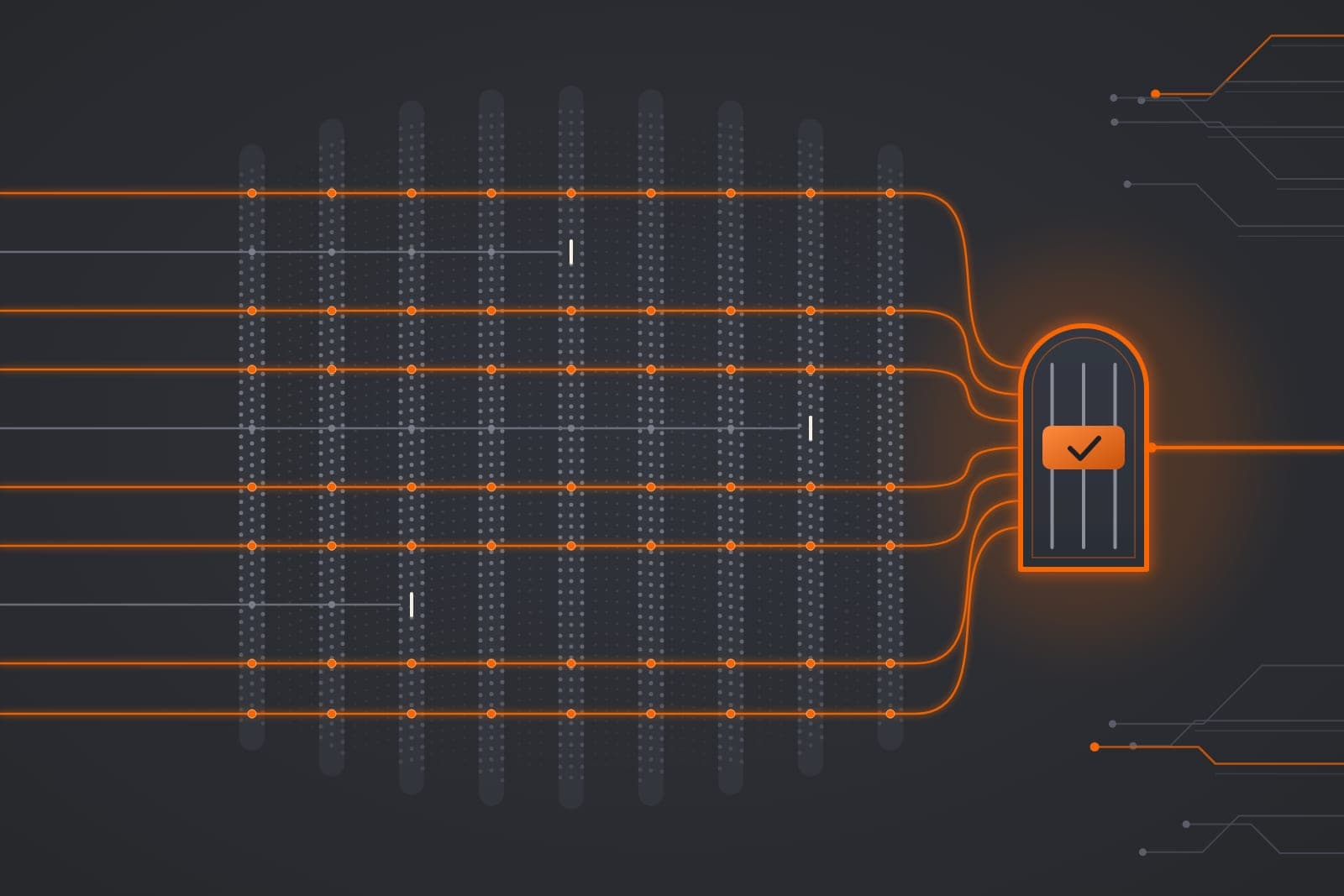
A tamper-evident ledger. The engine is designed so that every step is written to a record where each entry is chained to the one before it, so a later edit to a result shows. The ledger ties each requirement to the exact work, tests and version that delivered it.
Layer 4: Loop engineering
The loop is what lets the system run toward a goal instead of waiting for someone to type the next message. It starts with a defined finish line: the acceptance criteria and the tests that will prove each one, agreed before any building starts.
From there the agents plan, build, check and fix, then check again, until the gates pass. A failed test is not a dead end. It is the next input. The finish line is objective, so the loop knows when it is actually done, rather than when the model feels done.
Two controls keep the loop safe. Iteration caps stop a loop that is not converging, designed so that it does not spin forever on a problem it cannot solve. It stops and hands the problem to a person. And people sign off at defined points: the plan before building starts, and the finished result before anything goes live.
Why most people stop at layer one
Layers one and two are things you can do in a chat window. Layers three and four are not. They need infrastructure: isolated workspaces, test runners, gates, a ledger, a way to run many agents at once and keep them from colliding. That takes real engineering to build and harden, so most AI use stays at the prompt, and most of the value stays on the table.
Single-purpose agents versus an engineering engine
Most AI products on the market today are single-purpose agents. An agent is configured for one job: answering the phone, sorting an inbox, moving data between two systems on a schedule. That is process automation, and it is valuable. It is also bounded, because it cannot build what it was not given.
The agent works inside tools and rules that someone else designed for it. Our guide to what an AI agent is explains that kind of agent in plain terms, and our posts on agentic AI and agentic AI vs generative AI go further.
Our engine operates one level up. It is an engineering system that plans, builds, tests and ships software, including agents themselves. Business automation, process automation and fully custom software all come out of the same pipeline, under the same plans, tests and gates.
A construction comparison makes the difference concrete. A single-purpose agent is a skilled tradesperson with one tool: point it at a wall and it hangs the picture. Our engine is the architect, the general contractor and the inspection crew working together. It builds the house, and it can then staff the house.
The relationship runs in one direction only:
- A single-purpose agent cannot build an engineering engine.
- Our engine can build single-purpose agents, connect them to your existing systems and make them work together as one team.
How our AI engine works, step by step
Our engine is all four layers built into one system. A build moves from your plain-English ask to a written plan you approve, then through parallel builders, independent inspectors, a security group and a machine gate, with every step on the record and every fixed bug locked in by its own test.
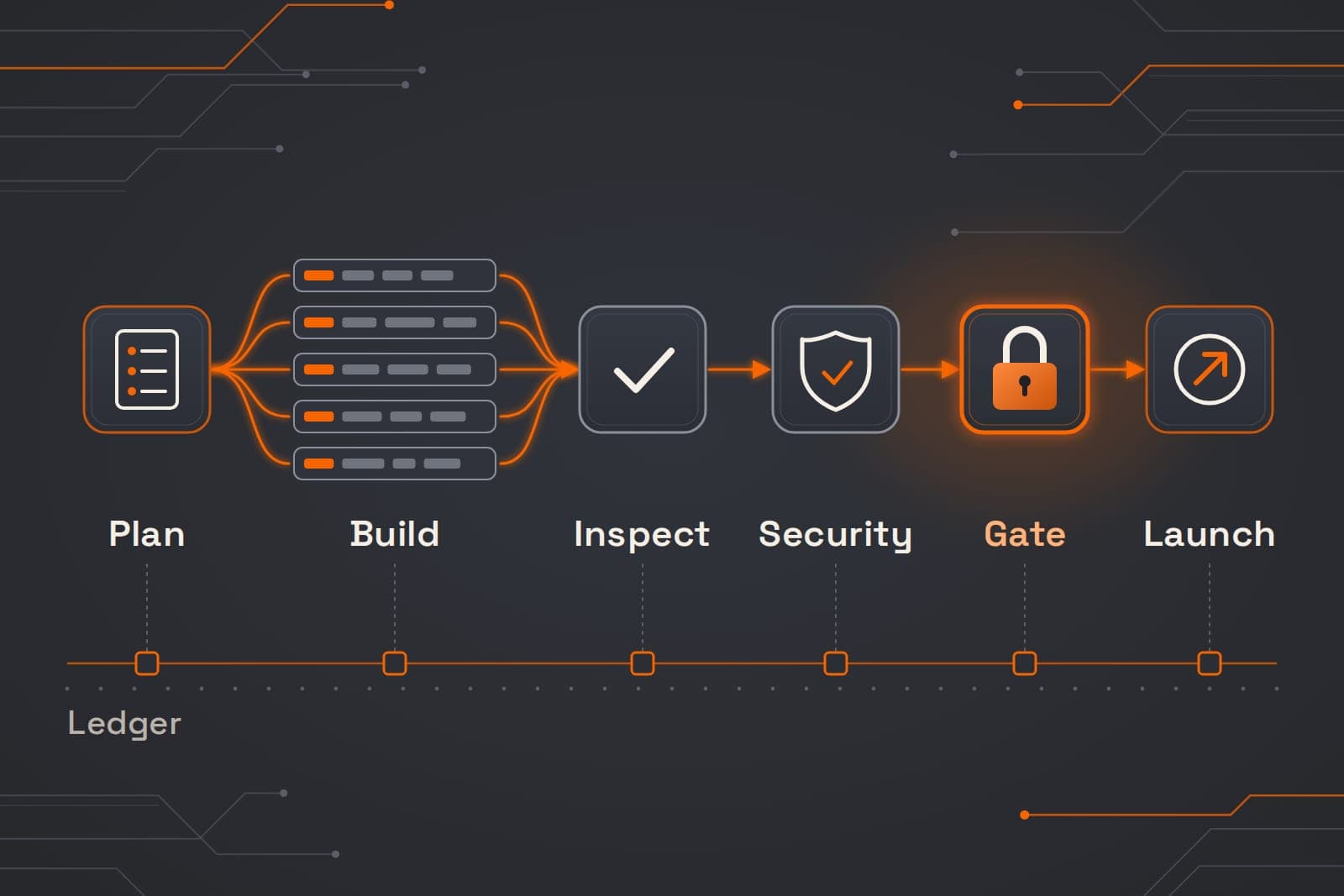
- A plain-English ask. You describe what you need in your own words. The engine turns that into a precise brief, designed so that every task is spelled out and nothing is assumed. Our guide on how to write a software spec shows what that description can look like.
- A planning group. For anything bigger than a quick fix, a group of AI specialists covering product, design, engineering and security works through the idea, with the scouts' map of your project in hand.
- A written plan you approve. You get every task, who owns which file so no two builders collide, and the tests that will define done. Nothing is built until you agree.
- Parallel builders, test-first. The plan is split into features. Up to twenty builders work at once, each owning one feature from start to finish in its own worktree. The tests exist before the code that has to pass them.
- Independent inspectors. Each feature faces fresh inspector agents. Anything they find loops back to be fixed and checked again.
- A security group. A separate group of agents attacks the assembled build the way an outsider would. That follows CISA's Secure by Design call (opens in a new tab) to build security into a product from the start. More on that on our Security page.
- A machine gate. The final inspection is run by code against the real build and the real tests. It is designed so that a failed check stops the work and cannot be waved through by anyone, including us.
- Every step on the record. The ledger ties each requirement to the work and tests that delivered it, and the documentation updates with the build.
- Every fixed bug locked in. Each bug we fix gets its own test, designed so that exact failure does not quietly return. More than 90 past failures have been turned into guardrails this way, so the engine is built to get harder to break with each release.
Always on the latest AI models
Our engine runs on the latest advanced AI models and combines several of them in every build, assigning each task to the model best suited to it. The most capable models take the work that demands the deepest reasoning: decomposing the request, writing the plan and conducting the final review.
Code-specialized models drive the parallel builders. Lighter, faster models handle routine steps such as lookups, formatting and status checks, the way a project is staffed with a senior architect and a capable team.
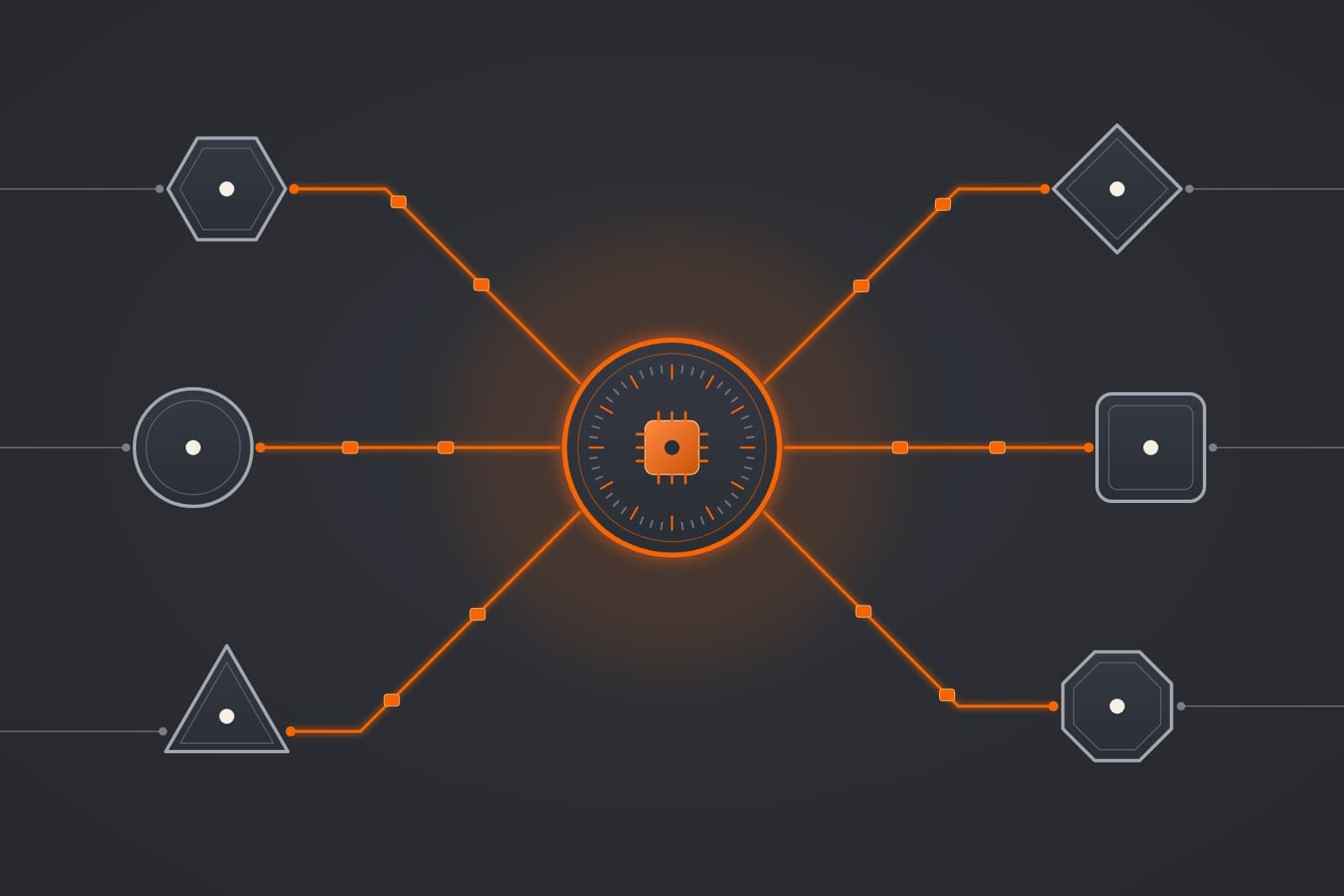
The lineup is not fixed. As new models are released, each one is evaluated inside the engine against the same gates and guardrails, and it is adopted only where it improves the work. Because the verification layer is independent of the model that wrote the code, a new model has to clear the same 26 gates and the same nearly 4,000 automated guardrails as the one before it. Every upgrade can raise the ceiling, and the gates are designed so that none lowers the bar.
That is also why the engine improves as AI improves. Each layer benefits directly from better models: stronger reasoning produces sharper plans and more rigorous reviews, larger context windows let more of a project be considered at once, and faster, more efficient models allow more parallel builders and more checks within the same build. The engine is designed to absorb each of those gains as soon as a model proves itself inside it.
What does not reset is everything the engine has already learned. Failures it catches become guardrails, requirements stay tracked in the ledger, and checks carry forward to the next model. Improvements compound instead of starting over: better models raise what the engine can build, and the guardrails are designed so that what it already does well is not lost along the way.
Why this process catches problems early
This process catches problems early because done is defined before work starts, the builder never grades its own work and machine gates run the same checks on the last day as on the first. The case is not about talent. It is about process.
Good developers and good agencies write good software every day. The failure modes every team knows are the same: one person reviewing their own code, "it works on my machine", a requirement quietly dropped in week three, an edge case nobody had time to test. Our engine is designed so that those failures are caught early.
- Done is defined before work starts. The acceptance criteria and tests are in the plan you approve. Nobody decides at the end what "finished" meant.
- The builder does not grade its own work. Review is done by agents with no memory of writing the code and no reason to go easy on it.
- Checks are designed to run the same near a deadline. People under pressure skip steps. A machine gate runs the same checks on the last day as on the first.
- Requirements carry over between sessions. Memory lives in the plan, the ledger and the test suite, not in anyone's head. A requirement written down on day one is still tracked on the last day.
- Many specialists work in parallel. Planning, building, inspection and security are separate roles, each done by agents set up for that one job.
- Changes are built to be traceable. You can follow any requirement to the code, the tests and the version that delivered it.
- It works on more than one machine. The gate runs the real build in a clean environment, not on the laptop where the code was written.
Practices like these are what NIST's Secure Software Development Framework (opens in a new tab) sets out to lower the risk of security flaws in software. None of this makes software perfect. It makes the process honest, so problems are found early, by a machine or an inspector, instead of late, by a customer.
What stays human
The engine builds, and people run the business. On every project, you decide what gets built and approve the plan, people set the finish line, a person decides prices, promises and anything that moves money, and you give the go-live sign-off after trying it with your own examples.
- You decide what gets built and approve the plan before anything starts.
- People set the finish line: what done means and what the checks must prove.
- Prices, promises and anything that moves money are decided by a person, never by an agent.
- You give the go-live sign-off. Nothing goes live in your business until you have tried it with your own examples.
The same holds for the software we deliver. Agents absorb repeat work. Your team keeps the judgment. Same team. Same jobs. More capacity. To see what the engine builds, from a small fix to a full platform, see what we can build. Our guides to custom AI development and AI for small business show where it fits.
Frequently asked questions
What are the four layers of AI engineering?
Prompt, context, harness and loop. The prompt is the instruction, the context is everything the model sees first, the harness is the checking and tooling around the model, and the loop runs the work toward a defined finish line until the checks pass.
Is code written by AI agents safe to run in my business?
It depends on how it is checked, not on who typed it. In our engine, code is reviewed by separate inspector agents, attacked by a security group and passed by machine gates that run the real build and tests before you see it. You still try it yourself before it goes live.
Does a bigger context window mean better results?
Not on its own. Models give uneven attention to long inputs, so piling everything in can bury the few facts that matter. Picking the right files, rules and examples for each task works better than sending everything.
Can the engine run forever if it gets stuck?
No. Every loop has an iteration cap. If the work does not converge, the loop stops and hands the problem to a person with the record of what was tried.
What is an AI engine?
An AI engine is a system that runs several AI agents together, with plans, checks and gates, so the work is more than one AI answering a question. Ours plans, builds, tests and ships software, and people approve the plan and the go-live.
Next step
If you have an idea or a bottleneck and want to see how the engine would build it, book a free workflow consult. We are based in the Kansas City metro and work with owners near and far, and we will show you plainly what the first build should be.
About the ScaleAlphaAi team
We are a Kansas City company that designs and builds AI agents and custom software for small businesses, trades and growing firms. We write these guides from our work with owners and office teams: what AI handles well, what stays with your people, and how to start with one workflow.
Meet the team