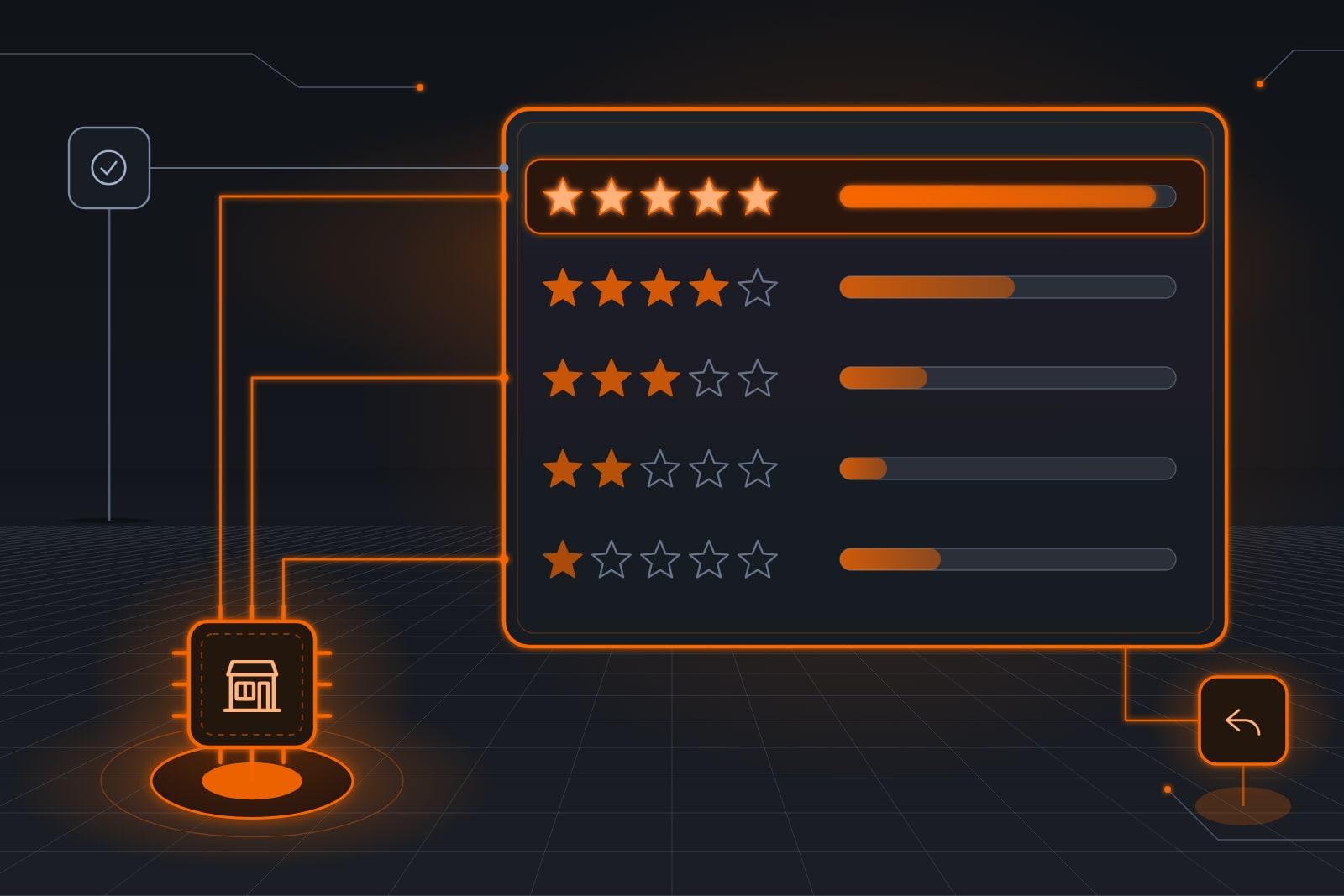
Online review statistics from nonprofit and university research show that reading ratings before buying is common. In Pew Research Center's 2016 report (opens in a new tab), 82% said they at least sometimes read online ratings or reviews before a first-time purchase.
Each source below is named with who it counted and when. The research is older and covers U.S. adults, online shops and hotels, so treat it as a rough guide rather than a forecast for your business.
For an owner, the practical job is to ask every customer the same way and answer what they write. The Customer Agent asks for reviews after each job and drafts each reply, and you approve every public reply.
Our guide AI Review Management: Requests, Replies and Human Approval sets out that routine step by step.
Where do online review statistics come from?
Pew Research Center (a nonprofit), Northwestern University's Spiegel Research Center and a peer-reviewed hotel study by Davide Proserpio and Georgios Zervas supply every figure here. Each counted a different group, from U.S. adults to online shoppers to hotels, in different years. The table names the group and year behind each headline figure.
| Headline figure | Who was counted | Source and year |
|---|---|---|
| 82% at least sometimes read reviews before a first purchase | U.S. adults | Pew Research Center, 2016 report (opens in a new tab) |
| 54% pay more attention to extremely negative reviews | Americans who read online reviews | Pew Research Center, 2016 report (opens in a new tab) |
| 270% higher purchase likelihood with five reviews than with none | Products at a high-end gift retailer | Spiegel Research Center, studies from 2016 and 2017 (opens in a new tab) |
| 4.34 average stars from verified buyers, 3.89 from anonymous reviewers | Product reviews at online retailers | Spiegel Research Center, studies from 2016 and 2017 (opens in a new tab) |
| 0.12-star rise in ratings and 12% more reviews | Hotels that responded to reviews | Marketing Science study, published in 2017 (opens in a new tab) |
The Spiegel team worked with a ratings and reviews software company to study three online retailers. Its figures describe shopping for products online, so a service business should read them as direction.
The study of hotels compared ratings across review platforms where the same hotels replied more often on some than on others. A repair shop or a clinic serves customers in other ways, so its own results can differ.
How many people read reviews before buying?
U.S. adults lean on reviews when they buy something new, and Pew Research Center's 2016 report (opens in a new tab) found 40% always or almost always read them before a first-time purchase. So a first-time buyer may well read your reviews before calling you about a job.
Younger adults read reviews most. In the same 2016 report (opens in a new tab), 53% of 18- to 29-year-olds always or almost always read reviews before a first purchase, against 23% of adults 65 and older.
If your customers skew younger, more of them may check your ratings before they book.
In the same 2016 report (opens in a new tab), around one-in-ten Americans said they nearly always post their own reviews of products, services and restaurants.
Since few people post every time, a short request after each job gives every customer the same chance to say how it went.
The same 2016 report (opens in a new tab) found 54% of Americans who read online reviews pay more attention to extremely negative ones, against 43% for extremely positive ones. So the reply under a bad review deserves your most careful words.
Trust is split. In the same 2016 report (opens in a new tab), 51% of those who read online reviews said they generally give an accurate picture, while 48% said it is often hard to tell if they are truthful.
That doubt is one more reason to keep every review honest, flaws included.
Do reviews change what people buy?
Reviews moved purchases on the online retail sites that Northwestern University's Spiegel Research Center studied. In its report on how online reviews influence sales (opens in a new tab), a product with five reviews at a high-end gift retailer was 270% more likely to be bought than one with none. Those are product pages, so a local business should read them as a pattern only.
The first reviews mattered most. At the same retailer, nearly all of the rise in purchase likelihood came within a product's first 10 reviews, and the first five drove most of it, in the report (opens in a new tab).
A business with only a handful of reviews is where a steady request after every job can matter most.
Across the retailers' categories, purchase likelihood typically peaked between 4.0 and 4.7 stars, and products averaging 4.7 to 5.0 stars were less likely to be bought than those at 4.2 to 4.7 stars, in the report (opens in a new tab).
The report suggests shoppers see a near-perfect score as too good to be true, so an honest mix of ratings is nothing to fear.
Customers who were asked rated higher. Ratings from verified buyers, who got an email after an online purchase asking them to review it, averaged 4.34 stars, against 3.89 for anonymous reviewers, in the report (opens in a new tab).
The report links the gap to selection bias, meaning the people who choose to post are not a fair sample. The authors hypothesize that very unhappy buyers are more likely to make the effort on their own.
Asking every customer after each job gives a fuller picture of your work than waiting for the motivated few.
Price raised the stakes. When the gift retailer displayed reviews, the conversion rate, meaning the share of shoppers who bought, rose 190% for a lower-priced product and 380% for a higher-priced one, in the report (opens in a new tab).
If you sell larger work, such as a brake job or a transmission repair, buyers may lean on your reviews even harder.

Does replying to reviews help?
Replying went with a small gain for hotels in one peer-reviewed study. The study in the journal Marketing Science (opens in a new tab) found a 0.12-star increase in ratings and a 12% increase in review volume for hotels that responded. Those findings come from hotels on review platforms, so your own business can see different results.
The hotels tended to start responding after their ratings fell, and they answered positive, negative and neutral reviews about equally often. We suggest answering good and bad reviews alike, so a reply does not read as damage control.
Responding also changed the complaints. Once hotels began answering, they received fewer but longer negative reviews, which the authors call a trade-off for managers. A longer complaint names what to fix, so read it for the pattern first.
The Customer Agent drafts a reply to each new review in your voice. You approve every public reply, and a bad review goes to a named person first, with the job details.
Our guide AI Customer Service for Small Business: What to Hand Off covers the other customer conversations worth handing off.
Want this routine running in your business? Book a free consult meeting, and we will show how the Customer Agent sends each request and drafts each reply for your approval.
What does the federal review rule ban?
The FTC's Rule on the Use of Consumer Reviews and Testimonials makes several practices a violation for a business. Its text covers, among others, fake reviews, rewards for a positive or negative sentiment, and threats or misleading displays that hide honest ones. We describe the text in plain words, and a lawyer can tell you how it applies to you.
- Fake reviews. Section 465.2 of the rule (opens in a new tab) bars a business from writing, creating or selling a review that materially misrepresents whether the reviewer exists, used the product or service, or what their experience was. It also covers buying such a review, or getting one from staff or their immediate relatives for posting on another site, when the business knew or should have known it was false.
- Rewards tied to sentiment. Section 465.4 of the rule (opens in a new tab) bars paying or giving other incentives for a review that expresses a particular sentiment, positive or negative.
- Review suppression. Section 465.7 of the rule (opens in a new tab) bars groundless legal threats, physical threats, intimidation, or public false accusations made knowingly or with reckless disregard for the truth, meant to stop or remove a review. It also bars a business from materially misrepresenting the reviews shown on its own site as most or all of those submitted, while it hides some for their rating or negative tone.
Review gating means screening customers first and asking only the happy ones for a public review. The text of Part 465 does not use that term.
One example in the FTC's Endorsement Guides (opens in a new tab) describes a marketer that invites only its most pleased buyers to post on other sites. The Guides say this may be unfair or deceptive if it leaves the posted reviews substantially more positive.
The same example then describes the fair way to ask.
"If, in the alternative, the marketer had simply invited all recent purchasers to provide feedback on third-party websites, the solicitation would not have been unfair or deceptive, even if it had expressed its hope for positive reviews." — Federal Trade Commission, Endorsement Guides, 16 CFR 255.2 at Cornell LII (opens in a new tab)
The Customer Agent sends the same request to every customer who agreed to hear from you, with no filter and no reward. For a contest, a giveaway or reviews from staff, ask a lawyer before you start.
What should an owner do with the numbers?
Each finding points to a fair, steady routine for asking and replying. Ask every customer the same way after each job, answer good and bad reviews with a person approving each reply, and keep the record honest. Then judge the routine by your own results, since these studies measured other businesses.
- Ask everyone. Send the same request after every finished job, in wording you approve.
- Answer all of them. Reply to good, neutral and bad reviews, with a person approving each public reply.
- Call first on a bad one. A named person talks to an unhappy customer before any public answer goes up.
- Keep it honest. No fake reviews, no rewards for a positive or negative sentiment and no hiding honest criticism.
- Measure your own shop. Each month, note how many customers got a request, how many reviews got a reply and what the complaints have in common.
Example: an auto repair shop sets a review routine
Anselm runs an auto repair shop with three technicians. He used to ask for reviews only when a customer seemed happy at pickup.
After reading about review gating, he switches to one request for every customer when a repair order closes. The Customer Agent texts customers who agreed in writing to get texts and emails the rest, in his wording.
One customer leaves two stars because a brake job ran a day past the promised time. The Customer Agent flags it to Anselm with the repair order, and he calls the customer that afternoon.
Anselm apologizes for the delay, then approves a short public reply that the Customer Agent drafted. It thanks the customer and shares no account details.
Each month he checks three things: requests sent, reviews answered and the most common complaint. He does not chase a perfect score.
Frequently asked questions
Do these figures apply to a local service business?
These figures apply only partly to a local service business. Pew Research Center's 2016 report (opens in a new tab) surveyed U.S. adults about first-time purchases, so it describes a broad public.
The Spiegel research measured online retailers, and the Marketing Science paper measured hotels, so test their lessons against your own reviews.
How old is the research behind these numbers?
All the research behind these numbers dates from 2016 or 2017: Pew Research Center's 2016 report (opens in a new tab), the Spiegel Research Center's studies from 2016 and 2017 (opens in a new tab) and the Marketing Science paper, published in 2017 (opens in a new tab).
Buying habits and review sites may have changed since then, so treat these numbers as a baseline and watch your own.
Is a perfect five-star rating worth chasing?
A perfect rating is a poor target, judging by the Spiegel Research Center's findings (opens in a new tab). In its studies, purchase likelihood typically fell as average ratings neared a perfect score, which the report suggests shoppers find too good to be true.
A steady record of honest reviews, each with a reply, serves buyers better.
Can a business ask every customer for a review?
Yes, and asking every customer the same way is the fair approach. Section 465.2 of the FTC's rule (opens in a new tab) says its parts on bought and staff reviews do not apply to reviews from a general invitation to buyers.
An example in the FTC's Endorsement Guides (opens in a new tab) says inviting all recent buyers would not be unfair or deceptive, even if the business hopes for positive reviews. Ask a lawyer about your own case.
Should every review get a reply?
Yes, every review should get a reply, whether it is good, neutral or bad. In the Marketing Science study, hotels answered all kinds of reviews at about the same rate.
A named person should approve each public reply, and an unhappy customer should hear from that person before the reply goes up.
Next step
Book a free consult meeting and bring a handful of your recent reviews. We will map when your jobs end, who signs off on replies and who calls an unhappy customer. If it fits, you can try the Customer Agent free for 30 days.
Our standards
- The examples in our guides are illustrations, not customer stories.
- Your AI runs on private and on-premise models, not public AI tools. Nothing you give us is used to train AI models.
- Agents are built so each action is logged in a record that shows any later edit.
- Texts go only to people who gave you permission, and every message says how to stop.
- If anyone may be hurt or in danger, the only instruction an agent gives is to call 911.
- Depending on the investment package you choose, you get either the right to use the software we build for you or full ownership of it.
- We work from the Kansas City metro and meet owners face to face or by video call.
- Same team. Same jobs. More capacity.
About the ScaleAlphaSi team
ScaleAlphaSi is a Kansas City AI advisory firm specializing in Advanced Marketing and AI Engineering. Our team drives demand through SEO, AEO, GEO and paid ads management. Once that demand arrives, we build specialized AI agents to scale operations for profitability. Each guide draws on engagements with owners and operations teams, covering where to start, where people stay in charge and how to scale one workflow at a time.
Meet the Team