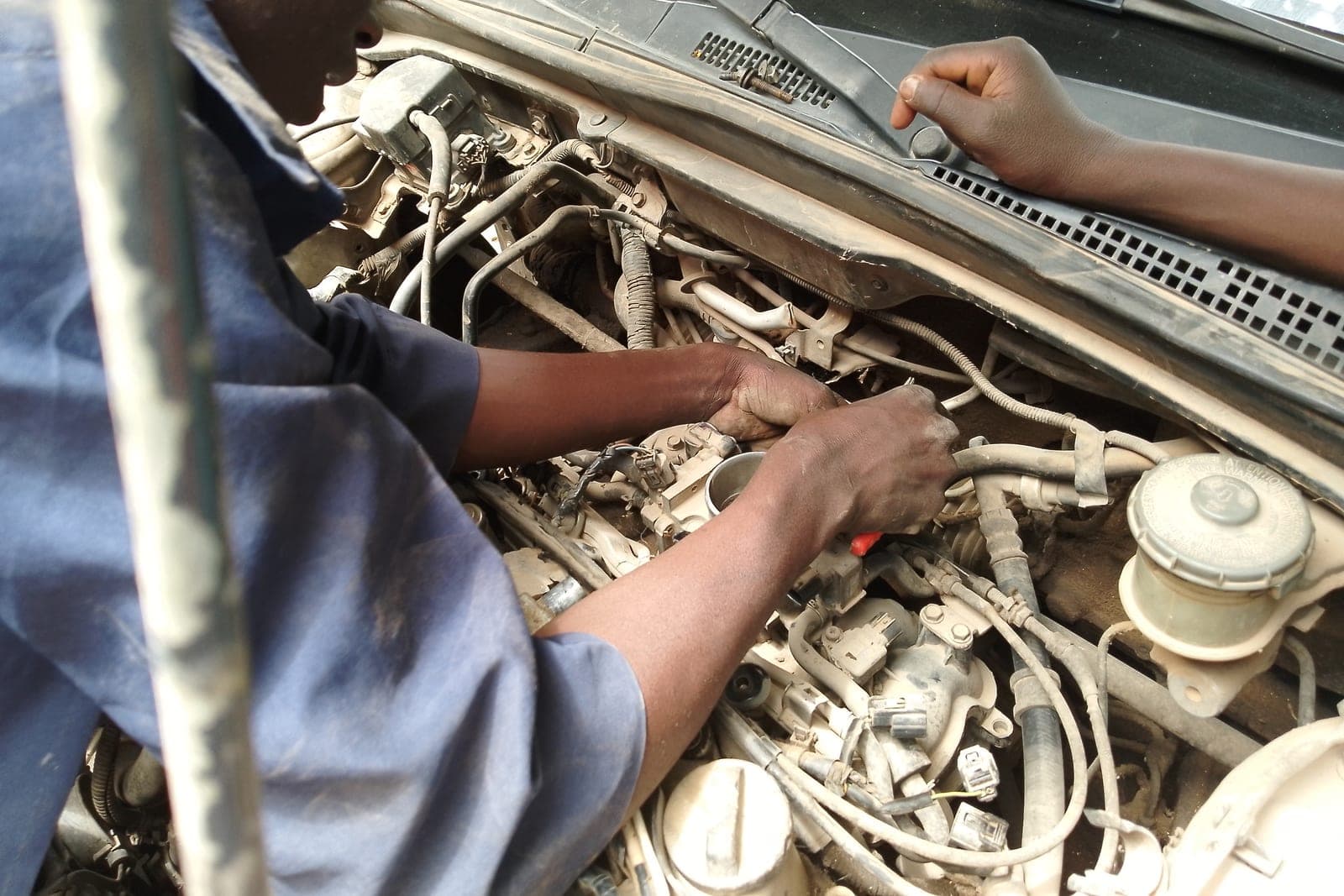
AI for auto repair shops in Kansas City helps most at the front counter: booking appointments by phone, text and web, sending repair status texts so customers stop calling to ask, and following up on estimates that were never approved. The agent handles the messages. Your techs keep diagnosing and fixing, and your service writers keep every conversation about price, repairs and safety.
This guide is for independent shops, tire and brake shops, and small multi-bay garages across the metro. It covers the three biggest time sinks at the counter, what an agent does with each, and what should always stay with a person.
Why is the front counter always so busy?
A shop's service writer does three jobs at once. They answer the phone, greet the customer at the counter, and walk the shop to check on cars. Meanwhile, customers call to ask whether their car is ready, people call for appointments during the lunch rush, and yesterday's estimates sit in a folder waiting for a callback.
Most of those calls are the same handful of questions. That makes them a good fit for an agent. The goal is not a shop with fewer people. It is a service writer who can finally finish one conversation before the next one starts. If missed calls are a big issue for you, our guide on AI phone answering for small business goes deeper.
How can AI handle appointment booking?
AI handles appointment booking by taking requests by text, website chat or phone, often after hours when customers want to book. It asks about the car and any warning lights, offers open times from your shop calendar, sends a confirmation and notes whether the customer will wait or drop off. It never diagnoses or quotes.
- Ask what is going on with the car, the year, make and model, and any warning lights.
- Offer open times from your shop calendar, based on the type of job and your bay capacity rules.
- Book the slot, send a confirmation and remind the customer the day before.
- Note whether they will wait, drop off or need a ride, so the counter is ready.
If a customer mentions brakes, smoke, a fuel smell or a warning light, the agent alerts a person right away with a summary and sets up a callback. If anyone may be hurt or in danger, the only instruction it gives is to call 911, and it alerts your on-call person at once. It does not diagnose, quote or judge whether a car is safe to drive. That is your team's work.
Can AI send repair status texts?
Yes, and customers often notice this change most, because "Is my car ready yet?" is one of the most common calls a shop gets. An agent sends short texts at check-in, after inspection, when parts are ordered, during the work and at pickup. It only sends updates a person has marked in your shop system.
- Car checked in and in line for inspection.
- Inspection done, and a service writer will call with the estimate.
- Parts ordered, with the expected arrival day.
- Work in progress.
- Ready for pickup, with your hours.
Only text people who contacted you or gave you permission, the contacts Missouri's No-Call law (opens in a new tab) still allows, and make opting out easy.
The agent only sends updates a person has marked in your shop system. It never tells a customer what is wrong or what it will cost. Your service writer makes that call, because that conversation builds trust. Our Customer Agent is built for this kind of front-line update with a clean handoff.
How does AI follow up on estimates?
Every shop has a pile of estimates for work that was recommended but not approved. Tires that are getting thin. A timing belt that is coming due. A leak that will get worse. Many of those customers meant to come back and simply forgot.
An agent can follow up on each one:
- Send a polite reminder a few days or weeks later, signed as your shop, to customers who said yes in writing to getting these texts. Every message says how to stop, in line with the FCC's opt-out rules (opens in a new tab), and we follow quiet hours.
- Remind the customer what was found, using the notes your tech wrote.
- Offer to book a time if they are ready.
- Hand the thread to a service writer if the customer has questions about the price or the repair.
Prices and repair advice always come from a person. The FTC's auto repair guide (opens in a new tab) tells drivers to get a written estimate that says the shop will ask before doing extra work. The agent keeps the conversation going and makes sure no estimate is forgotten. Our Sales Agent handles this kind of follow-up. For shops that also sell service plans, see maintenance plan software.
What stays with the service writer and techs?
Diagnosis, estimates and prices, safety calls about whether a car is fit to drive, and warranty questions or comebacks stay with the service writer and techs. An auto shop runs on trust, so payments, refunds and hiring decisions stay human too. The agent books and updates, and people make every judgment.
- Diagnosis and repair recommendations.
- Estimates, prices, discounts and approvals.
- Safety calls about whether a car is fit to drive.
- Warranty questions, comebacks and complaints.
- Payments and refunds.
- Hiring, pay and schedules.
Same team. Same jobs. More capacity. Your service writer spends more time explaining repairs and less time answering "is it ready?"
What does this look like in a real week?
This is an illustration, not a customer story. Picture a four-bay shop in Independence.
On Monday, the agent books six appointments that came in by text over the weekend. Through the week, it sends status texts for every car on the lot, so the counter phone gets quieter. On Wednesday, it follows up on last month's open estimates, and two customers book times for brake work. On Thursday, a customer texts about a grinding noise and asks for a price. The agent books an inspection and tells the service writer the customer wants a call. The service writer makes that call and gives the quote.
The techs did not change how they work. The counter just got calmer.
Getting started with AI for auto repair shops in Kansas City
Many shops start with status texts or estimate follow-up, because both are quick to set up and easy to measure. We map how the counter works today, write a plan you approve, and build it inside the shop software you already use.
Before launch, inspector agents and separate AI security agents try to break it. The Starter Upgrades page shows all six ready agents, and our guide to AI for small business explains how a shop can add them one at a time.

AI receptionist for auto repair shops: the calls the counter can't get to
An AI receptionist for auto repair shops picks up the calls your service writer cannot reach: a line at the counter, everyone out in the bays, or after you lock up. It books drop-offs and answers routine questions from your own shop records, while every repair conversation stays with your service writer.
Most of those calls are simple. A customer wants to bring a car in Thursday for an oil change and a look at a squeak. The receptionist books the drop-off and asks whether they will wait or need a ride. The note lands on your calendar.
Another caller wants to know where their car stands. The receptionist reads the job status your team set in your shop software and says that, nothing more. If the job is waiting on an estimate approval, it says a service writer will call. That callback goes to the top of the counter's list.
Tow-ins and breakdowns are different. A caller may be stuck on the shoulder or say the brakes feel wrong. The receptionist alerts a person right away with a summary and sets up a quick callback. If anyone may be hurt or in danger, the only instruction it gives is to call 911, and it alerts your on-call person at once.
Diagnosis, estimates, approvals, prices, comebacks and upset customers go to a service writer, along with who called and why.
We can set up the Customer Agent to back up your counter phone in the rush and after hours, book drop-offs and tow-ins, and hand your service writer a clean callback list. Every call and text opens with a short line saying it is the shop's AI assistant, and asking for a person always works.
More guides for auto shops
- Answering Service for Auto Repair Shops: Car Status Calls: the steady stream of status calls.
- Auto Repair Shop Estimates: Follow Up on Declined Work: following up on work a customer declined.
- Auto Repair Shop Scheduling Software: Bays and Drop-Offs: bays, drop-offs and waiting customers.
- Auto Detailing Scheduling Software for Mobile Detailers: packages, vehicle size and mobile visits.
- Auto Detailing Quotes: Ceramic Coating and Paint Correction: quotes for coatings and paint correction.
- AI for Car Dealerships: Leads, Test Drives and Service: for stores with a sales floor and a service lane.
Frequently asked questions
Does it work with our shop management software?
Agents work inside the tools you already use. In the consult we look at your systems and tell you plainly what connects. If a system cannot connect, we say so before you spend anything.
Will customers know they are texting with AI?
Yes. Every call and text opens with a short line saying it is the shop's AI assistant, and asking for a person always works. Anything about price or safety goes to a person.
Is customer and vehicle data safe?
Your data is never sold and is shared only with the services that run your agents, and nothing you give us is used to train AI models. Each agent gets only the access it needs. Read our security practices.
Next step
Book a free workflow consult. We look at how calls, updates and estimates move through your counter, show you where the time goes, and give you a plain-English plan.
About the ScaleAlphaAi team
We are a Kansas City company that designs and builds AI agents and custom software for small businesses, trades and growing firms. We write these guides from our work with owners and office teams: what AI handles well, what stays with your people, and how to start with one workflow.
Meet the team